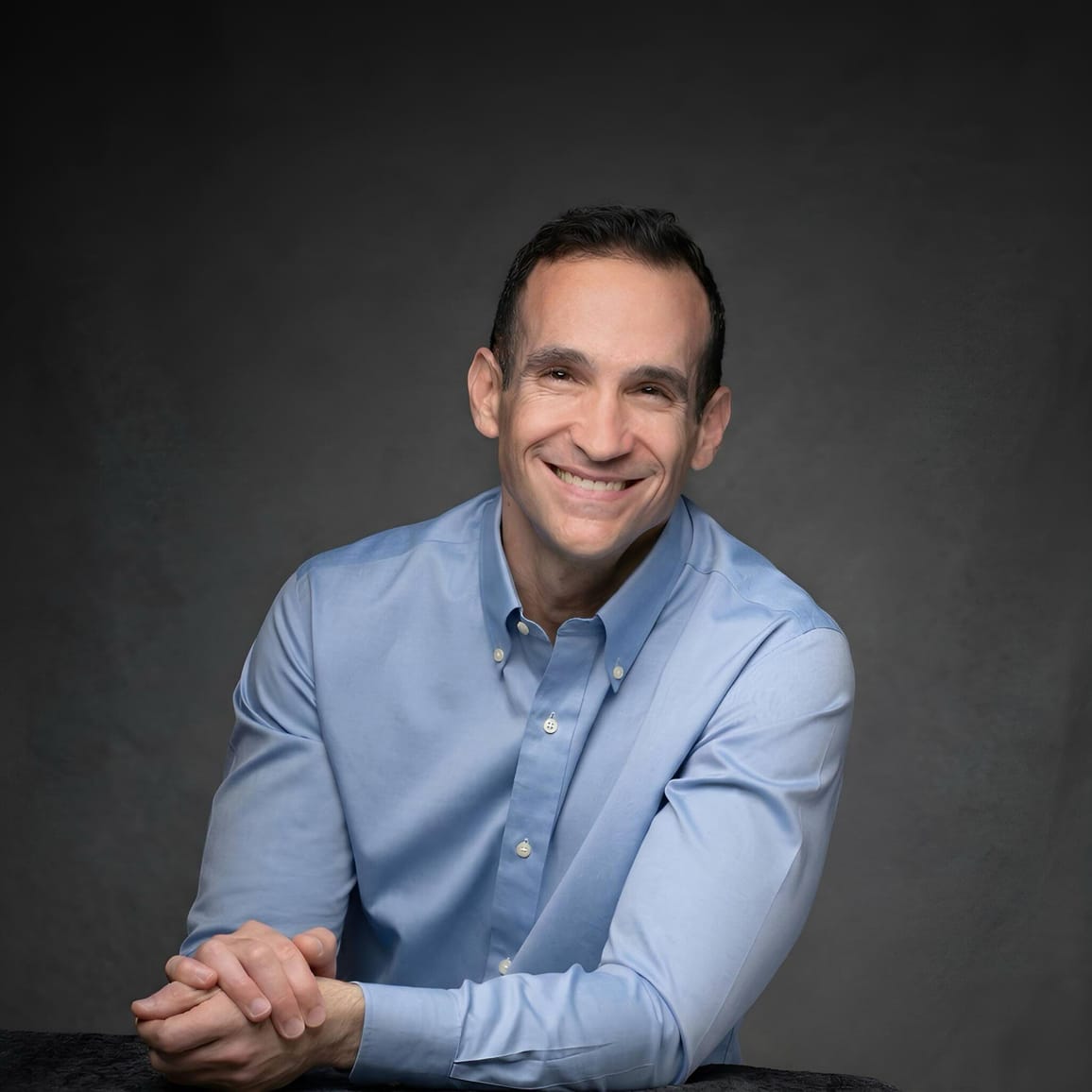

The Truth About China's Generative AI Revolution Nobody Talks About with Grace Shao


Fresh out of the studio, Grace Shao, founder of AI Proem Newsletter and former CNBC and CGTN journalist, joins us to explore the rise of generative AI in China and how it's reshaping the global technology narrative. She began the story of her career journey and started with the conversation reflecting on how the DeepSeek moment revitalized China's internet sector after years of regulatory challenges and geopolitical tensions. Grace unpacks the pragmatic Chinese approach to AI development, explaining how companies like ByteDance, Alibaba, and Tencent are leveraging their unique ecosystems and data advantages while startups embrace open-weight models to prove innovation over imitation. She discusses why the "China versus US AI arms race" narrative misses the point, the strategic reasons behind companies relocating to avoid geopolitical sensitivities, and how distribution challenges are separating winners from losers in the consumer AI space. Addressing the broader implications, Grace explores the real opportunities in robotics, vertical AI applications, and why collaboration rather than competition should define the industry's future. Closing the conversation, she shares her vision for bridging cultural understanding between East and West and what success looks like for the next generation of AI development.
"China's approach is very pragmatic. People have been saying DeepSeek did it out of necessity. There's obviously a GPU constraint and hardware constraint in China, something they're working around. In many ways, the engineering genius and engineering innovation is what set DeepSeek apart. It challenged a global narrative around needing more GPUs and more money to get better AI. It was about throwing capital at the problem. It was a different approach because the capital ecosystem in China itself is very different. People talk about proof of concept - you have to prove your concept first in China to get funding. For many startups, they weren't getting much funding before the DeepSeek moment. To your point, no one really knew it would have a strong ROI, so only the BATs that had money and understood the technology were backing it." - Grace Shao, Founder of AI Proem Newsletter
Profile: Grace Shao, Founder of AI Proem Newsletter (LinkedIn)
Here is the edited transcript of our conversation:
Bernard Leong: Welcome to Analyse Asia, the premier podcast dedicated to dissecting the pulse of business, technology and media in Asia. I'm Bernard Leong, today we're diving into the rise of generative AI in China. With me is Grace Shao, founder of the AI Proem Newsletter, a sharp observer of China's tech scene. She's a former technology reporter with CNBC and CGTN, with experience in crisis communications for major tech companies. Today we'll explore deep insights on the interplay of innovation and geopolitics in the China AI ecosystem. Grace, welcome to the show.
Grace Shao: Hi Bernard. Thank you for having me today.
Bernard Leong: It's interesting because you've been covering China's tech scene and the rise of generative AI companies. This dates back three years after ChatGPT's rise when everyone asked, "Where's China's ChatGPT? Why did they miss that?" Before we get there, I want to start with your origin story. How did your career begin? What led you to journalism and eventually to AI analysis and commentary on tech scenes?
Grace Shao: I don't usually advertise this, but I studied finance in undergrad, so I started my career in finance. It brings everything together now as a business analyst. I don't position myself as a journalist anymore - I provide analysis, insights on the happenings of big tech and startup AI ecosystem in China, how they're commercialized and monetizing. I studied finance, but when I joined a hedge fund as a TMT analyst intern, I realized I wasn't good with numbers. I was a people person who loved storytelling. I'd always been extroverted and loved talking to all walks of life. I studied financial journalism and moved to Beijing. My parents are from Beijing, I wanted to understand their background, history, and culture.
I got my first role there. I worked for CGTN in Beijing, which is the biggest broadcaster in China, and it allowed me to travel across China, see the country from a completely different lens. I traveled to third and fourth-tier cities, rural areas. It made me fall in love with this part of the world, so I stayed. After that, I joined CNBC in Singapore, mainly focusing on the APAC business and tech sector with a China focus, given how relevant it is for this part of the world. A couple years ago I started working for Alibaba in their strategic communications department, managing corporate PR and crisis management during the most tumultuous years. I joined a consultancy and advised tech firms like PayPal, Lenovo, and others. Those experiences shaped my interest in where I'm at now. I bring everything from working in-house in corporate to journalism to analyzing companies from an investment perspective to my newsletter.
Bernard Leong: You have a very diverse background - the ins and outs of being on the CNBC side, the Alibaba side, and now your current setup. What are the biggest takeaways from observing the tech sector specifically in China?
Grace Shao: Everything moves so fast. It's ever evolving. A personal anecdote: during COVID, I was mostly in Hong Kong. I didn't go to mainland for a couple years. When I got there for the first time in three years, I was trying to order food and asked the waitress, "Excuse me, could I order food?" She looked at me like I was a bizarre human. Why was I speaking to her? At that point, everything was digital. You're supposed to scan the QR code on your table, order everything. The only thing they were supposed to do was bring the food to you. This was when robot waitresses weren't even implemented yet. Things are moving so fast. Digital payments are omnipresent. Every time I go up, which is every couple of months, I'm shocked by new technology or evolution in the digital ecosystem.
Bernard Leong: My friend Patrick McGee, author of "Apple in China," says China's speed is incredible.
Grace Shao: Yes.
Bernard Leong: What inspired you to start AI Proem? How does your work help bridge understanding of AI in China with the rest of the world?
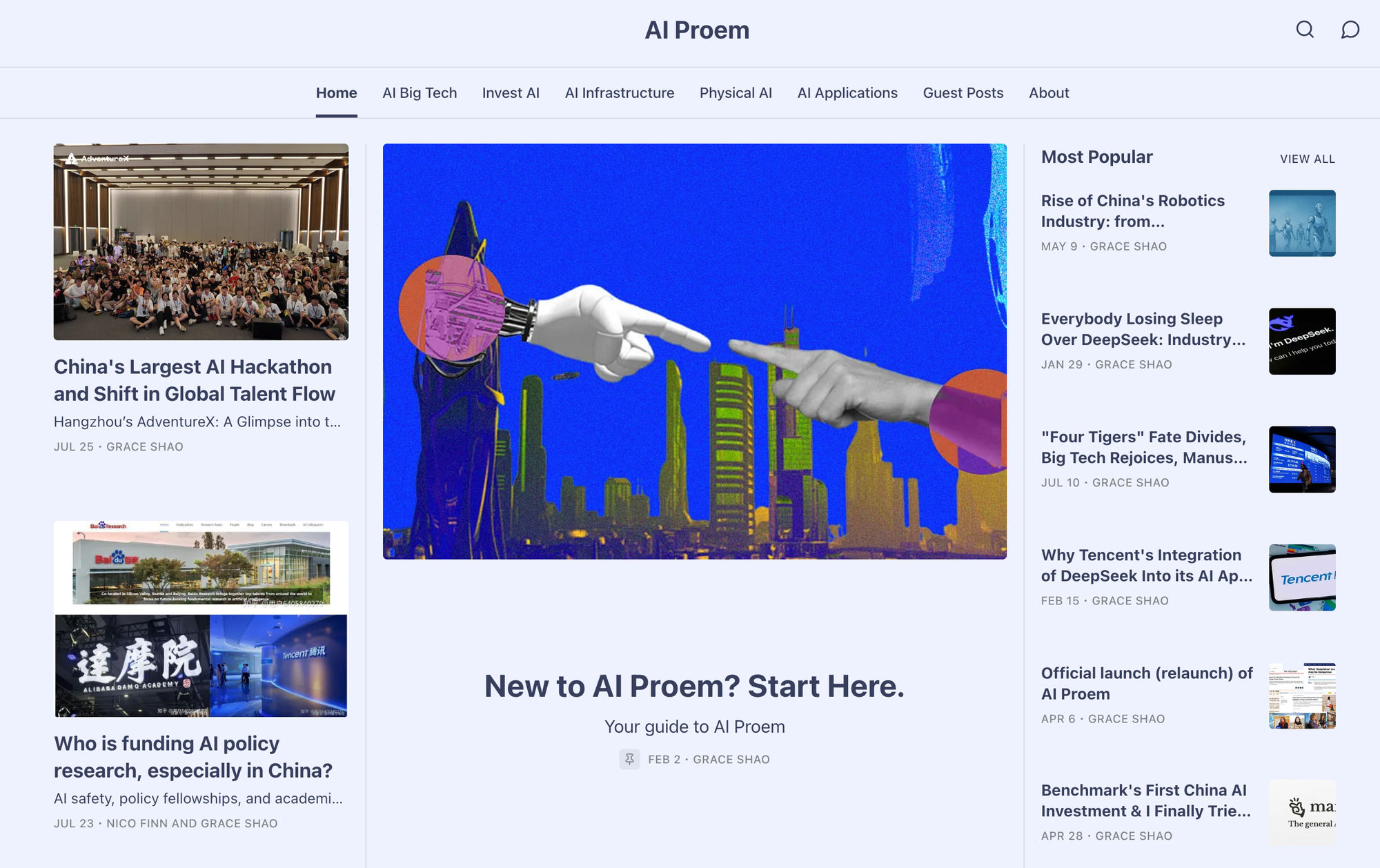
Grace Shao: I've been on different sides and worked in these tech companies for so long. I felt there was so much being overlooked. Since 2018 when the trade war broke out, many stories were hijacked by high-level geopolitical narratives. For someone passionate about telling stories of businesses and innovation, someone who personally straddles two worlds of the West and East, China and the US, I felt there was more I could do to bridge that knowledge gap. That's why I started AI Proem, writing about what interested me and people around me - mostly academics and investors. It took off on its own.
Bernard Leong: I relate to that. Even though I'm Singaporean, culturally I'm Chinese, trying to bridge understanding. Let's put aside politics and focus on technology and what's happening in China. What key lessons from your career journey can you share with my audience?
Grace Shao: I'm still humbly at the beginning of starting AI Proem. I just hit my one-year mark, so there's much for me to learn. What's been pleasantly surprising on this journey compared to working for big platforms or companies is that when you keep an open mind and have thick skin, say yes to opportunities, surprises come to you. My advice would be: don't be scared to try new things. Say yes to coffee chats, conversations. You never know what you can learn or where it'll lead.
Our conversation now happened because you dropped a message on LinkedIn. I didn't know much about your podcast at first, but I found this world of interesting interviews with extremely high-caliber people. I've learned so much from your interviews. I'd say be open-minded and say yes.
Bernard Leong: That's a great lesson. Let's get to the main subject - the rise of generative AI in China. Can you paint a picture of what the generative AI landscape in China looks like right now?
Grace Shao: That's a big question.
Bernard Leong: We can start with foundation models. Everyone hears about DeepSeek, but let's dive into that picture with foundation models, not just DeepSeek alone.
Grace Shao: We can talk about different players in the LLM [Large Language Models] space. First, there are startups like DeepSeek and Moonshot, which came out with Kimi two weeks ago that shook the world again. There are other LLM startup players, especially the original four tigers: ByteDance, Zhipu, Minimax, and Moonshot.
Then we have big tech players similar to how the US is set up. We have the BATs - in this case, referring to ByteDance, Alibaba, and Tencent.
Bernard Leong: Baidu's not involved now?
Grace Shao: It's evolving. At this point it's not as frontier compared to others in terms of models and applications. We see the ecosystem like that. Then we have smaller research labs still in incognito mode, many spinning out of universities. You meet them here and there, but they're not on the global map yet.
In many ways it's similar to the US - you have startups and big tech. A big difference is that out of the startups, aside from DeepSeek, almost all have some financial tie or partnership with one of the BATs. Many have been financially backed by Alibaba or Tencent, who are more aggressive investors and incubators in the internet and AI space since 2023.
If you look at the practicality of how people see it differently from the US, Chinese people are fundamentally pragmatic. When you talk about LLM research labs, there seems to be a bigger push to commercialize or go to market quicker. The idea of AGI is the holy grail for everyone in this space, but when I speak to people practicing in Silicon Valley versus China, the philosophical approach to AGI [Artificial General Intelligence] in the US is a much bigger driver. In China it's: "How do we come up with the best model? How do we make it most efficient? How do we make it cost-efficient and effective? Then how do we commercialize?" There's definitely that pragmatic approach. Another thing we can touch on is the open source and open weight approach.
Bernard Leong: I'm curious - the objectives look different. It's not like the US where they talk about winning the AI race, not wanting China to reach them. There wasn't that race mentality. In China, it's specifically about getting AI out to the market and little mentions about getting to AGI, but how do we commercialize? How do we get it into common people's hands? How do we make different applications? Since we talked about foundation models, how about applications? In the US you think of code development platforms like Cursor, Windsurf, or others like Lovable for creating websites, Gamma for presentations. How is the applications layer for generative AI in China?
Grace Shao: I think the US versus China narrative is unproductive. In terms of applications, in some cases it's similar and some cases it's not. Let's look at the players. On the BAT level, Alibaba is taking a Microsoft-like approach where cloud infrastructure is the core. That's what they're trying to sell. Alibaba Cloud has seen double-digit growth over the last few quarters. They're selling to enterprise - cloud services and enterprise software with AI add-ons that enhance efficiency for vendors, stores, and merchants. That's an enterprise-focused approach. Their consumer side isn't doing as much - they're not putting many resources there.
They have the Qwen series, the open source model that's been in the limelight and ranking high on Hugging Face. ByteDance is taking a different approach. They've been diligently trying to compete on the frontier model end. They were low-key for a while. Pre-DeepSeek, they actually had the best chatbot or pre-Kimi, they were the best chatbot. They have an app called Doubao that hit over 400 million MAU after aggressive marketing. The issue is there's a lack of functional adjacency to their core product. If you're swiping on Douyin, which is equivalent to TikTok, you're not interacting saying "Hey chatbot, tell me this, do this." It's more passive consumption.
Bernard Leong: Because Douyin is a video service that doesn't rely on social interactions.
Grace Shao: Exactly. It's more consuming, not interacting. They pushed out various AI enhancement products within Douyin to help with algorithms and e-commerce, but in terms of Doubao the chatbot itself, there was aggressive pushing.
Tencent took a completely different approach, which was interesting and a pivotal moment for China's consumer application end. They had their own LLM, but Tencent is known to work in silos. Anyone who knows the Chinese ecosystem knows they're competitive internally - each team works on their own things. The WeChat team decided to integrate DeepSeek into their chatbot and skipped over Yuanbao, which is their LLM. It's crazy because it worked in their favour due to functional adjacency and their walled garden mode. When you're chatting with a friend on WhatsApp, it's essentially a chat box, so it's natural to open up a chat box with your ChatGPT-like bot to ask questions, use search functions.
People in the West often don't understand that WeChat isn't just a social media app. It's literally a content platform. People run blogs, post videos - it's like YouTube plus Medium plus everything altogether. You have all this content and data available to Tencent that others can't access. When you search stuff on WeChat, it doesn't come out elsewhere. You have to search within WeChat. They have this huge dataset, so immediately they could tap into 1.2 billion users. It was game over on the consumer end. They've done well in terms of consumer applications, but they're not leading in frontier model development compared to Alibaba or ByteDance. ByteDance recently came out with another series: Seed LLMs focused on text-to-image and text-to-video. Who has better video and image data than ByteDance?
Bernard Leong: Can I ask if I'm interpreting this correctly - ByteDance's strength is in video and audio, not just Douyin but also CapCut. Many underestimate how much content creators use CapCut for taking long-form content, cutting it into reels for TikTok and other platforms. It seems ByteDance is specializing toward multimodal large language models where they're better in audio or video. Am I getting that specialization correct? They're not as good at text compared to DeepSeek or Qwen. There seems to be little understanding from the rest of the world about Qwen models. DeepSeek heavily distilled not just from Claude or OpenAI, but also from Qwen models, which is why the accuracy is so high.
Grace Shao: ByteDance seems like they made a pivot recently with their April launch, but before that they were still trying to compete with Doubao on the text side. Kuaishou is another major short video player in China - not as prevalent in North America but big in LatAm and EMEA markets. They came out with amazing products called Kling that were supposedly comparable to Midjourney. That was a triggering moment for ByteDance. You saw them go low-key for a few months then push out this amazing series of image and video multimodal models. There's definitely companies playing into their strengths with different leverages and unique walled garden databases. At the end of the day, it's a data competition. They also have unique distribution. If we step back to talk about startups versus big tech, what you're seeing is startups in China struggling with distribution and reach because you have to onboard new users on the consumer end versus big tech that has captured massive ecosystems. To give context, I read that for average Chinese consumers, you open less than 10 applications a month because you can use literally WeChat or Alipay to do everything in your life - chat, pay bills, get transportation, order food, whatever. In the West, most people in North America or Europe use upwards of 30 apps to finish day-to-day tasks. Your utility bill is one app, credit card bill is one app. In China, your ecosystem is completely owned by one of these BATs, so you have to capture value within that.
Bernard Leong: That comes to the point I always explain to Western counterparts when they ask about super apps. I tell them there's no chance for a super app in the West because your company culture is focused on building one thing very well and perfectly. Your Google search is perfect, Facebook is social networking. When you start encroaching on everyone's territory, it's an uphill battle because everything is state-of-the-art. In China, you don't have that situation. Some things they innovated on top of, leapfrogged, and it's hard to copy. They integrated the full stack. That's why they can have super apps, why Southeast Asia has super apps, why Europe has super apps, but you'll never see that in the US.
Coming back to consumer behavior and enterprise needs - when ChatGPT first launched, many questioned why China didn't launch it first. The transformer algorithm was available. DeepSeek emerged and basically put all counterparts in this new AI race. What lessons can we observe from this DeepSeek moment change in the China AI ecosystem?
Grace Shao: I don't know why Liang Wenfeng didn't want to release this model before OpenAI. I wish I knew, but maybe it legitimately wasn't ready yet. In terms of this moment, an interesting observation and feedback I've heard from people in the tech industry in China is that it helped China's internet revitalize because we know 2022-2024, China's internet hit a rough patch. The darlings were all hit - ADRs dropped. It was caused by domestic regulatory reasons: anti-monopoly probes, data security concerns. Didi had to face delisting. All these crises accumulated, meaning the global capital world was concerned about China.
Chinese tech companies went into panic mode. Everyone went back into their shells. No one said much from a PR perspective. People stopped talking - it's better to not stick your head out than stick it out and get hit. There was blocking energy. Domestically after COVID, there were cuts like in the West - headcount cuts, talent retention issues, salary caps. All these issues added up and didn't feed into positive energy for the Chinese AI and tech sector.
DeepSeek completely changed that narrative. Whether from media or companies themselves, it allowed the world to shift focus from "China bad" or "China internet bad" to finally: "Oh, innovation, business cost efficiency." Things that were overlooked for two-three years were brought front and center again. Companies could openly talk about what they'd been developing. For example, Damo Academy at Alibaba handles machine learning and LLM research. They've been doing this for a while - it's not like DeepSeek came out and Qwen suddenly appeared. The team's been around, but riding off DeepSeek's positive PR vibe, they could say "Hey look, we've been doing this too. Look at Qwen." It was a pivotal moment. When I speak to senior executives at these tech companies, they say they were relieved because suddenly the media - Wall Street Journal, FT - could talk about them as real businesses again versus just viewing them as a weather vane for China's geopolitical issues or lackluster consumer consumption. That was the pivotal moment.
Bernard Leong: It's interesting to examine because I'm technically trained as an AI practitioner with friends working with known technology companies in Europe, China, and the US. We're all in technical forums. When the DeepSeek paper first came out in late November, people were talking about it. I can share an anecdote: somebody had proposed things like certain methods DeepSeek was using, "Maybe we should try this at scale." Usually, American counterparts would say, "Well, you don't really need to try these methods because we just need NVIDIA chips. Just throw money at the problem." That irritates everybody. Now everybody got a shot in the face saying "What do you mean you can't do that? People told you so".
It's amazing that one thing DeepSeek has done is showing you can make this cheaper. It doesn't belong to any one country - there's a real horse race now. After DeepSeek, you start seeing Kimi and Manus AI. Yesterday Alibaba put out a new Qwen model at the top of the Hugging Face leaderboard, gathering attention. What sets them apart in China's AI ecosystem? Are there similar players? I heard of a company called Zhipu. What are the ones gathering attention that are one step ahead of rivals within China?
Grace Shao: First, addressing your commentary about what DeepSeek really meant: China's approach is very pragmatic. People have been saying DeepSeek did it out of necessity due to GPU and hardware constraints in China. In many ways, the engineering genius and innovation is what set DeepSeek apart. It challenged a global narrative around needing more GPUs and money - just chucking capital at it. It was a different approach because the capital ecosystem in China is different. People talk about proof of concept - you have to prove your concept first in China to get funding. For many startups, they weren't getting much funding before the DeepSeek moment. No one really knew it would have strong ROI, so only the BATs that had money and understood the technology were backing them. That's why BATs were the first round of investors and incubators in this space.
I would separate this discussion. Let's talk about DeepSeek and Kimi first, then Manus separately - they're very different. The DeepSeek-Moonshot situation is interesting because they're not anomalies. You realize it's not a one-off high-flyer group of geniuses who found a way to make more cost-efficient frontier LLMs. Other research labs are catching up.
One big difference comparing these to leading US startups or companies like OpenAI and Anthropic is that they fully embrace open weight. People call them open source, but technologically they're essentially open weight models. There's been discussion around this. There's a pragmatic reason and philosophical component.
Liang Wenfeng has come out - he's media-shy but has said he wants to attract the best talent. It's the best way to retain top talent, put the most frontier technology available in China in the hands of other innovators. He wants it massively adopted. He wants to put Chinese innovators at the front of global innovation leadership. There's a strong patriotic component.
There's also a philosophical choice where he believes - this is long debated in open source versus closed source communities, even in technology beyond AI - is it better to share technology for more people to innovate on top of it, be scrutinized and adopted? Or is it better to have your proprietary information and data closed up? For him it's a personal, philosophical choice to be open source.
Another interesting thing is that many founders in the AI space are young, born in the eighties or nineties. They grew up when China was rising economically with strong soft power. There are cultural and social aspects. People were like, "If I put this out there, I can prove we're not copying. We're actually innovating." That "copy-cat" mentality - there's a chip on their shoulder. The generation before them were called copy-cats. They wanted to prove themselves as innovators. There's a psychological, cultural aspect.
Last, the pragmatic reason goes back to distribution. For them, foundation models are becoming commodities. How they view it: value will be accrued in products and services built on top of them. Open sourcing is a strategic decision. You open source, utilize and leverage other people's distribution, create moats. You can have a great model, but everyone will use your model eventually if you continue to lead in frontier models.
There are different reasons why they came out the way they did. It's been different from how American research labs approach frontier models.
For Manus, I feel quite differently. I was lucky to get access early and tried it out. It was cool - everything was moving super fast, screens going crazy. Clearly impressive from a non-technical person's perspective. End of the day, the product itself from my personal usage and friends around me for research and simple tasks wasn't that different from OpenAI's O1 or any leading agentic products.
What they did interestingly was the PR. They had a founder who wasn't media-shy, was eloquent in English, and did a strong PR push. This was different from majority of other startup founders who are nerdy researchers, media-shy, not coming out to talk about their products. They didn't go founder-direct. People don't know about them as much. First, they did strong consumer marketing and PR. Second, they played into the scarcity strategy. For people who know, they weren't giving out access codes even to leading top-tier media globally. People were begging for them, thought it was exclusive, but really it was a genius marketing strategy. They rode that hype in the beginning. I'm not saying their product isn't good - I don't think it was significantly better than other players. Another big thing they've done differently is they've moved out to Singapore.
Bernard Leong: Yes, I know they're in town. I'd like to meet and interview them.
Grace Shao: Yes.
Bernard Leong: Hey, if you ever talk to them, please let them know about the podcaster in Singapore who covers Asia. I'm joking, but I want to understand - I know Manus also runs on Claude 4.0 now because of how it executes agent workflows. I look into all the computer lines they're running. When I teach classes, when I showcase Manus to business leaders, I put my phone with the Manus app on with a task running. I tell the class, "Let's wait for a while." I have my phone on just to see what the app was doing. By the end, "Here are the results," and everybody has this prestige moment. How did they decide to move out of China? It's probably very competitive within China, but they're quite in the lead in terms of agent AI.
Grace Shao: There are a few reasons. One is the huge pullout of US capital in China. Prior to 2022, many US private equity and venture capital firms had large presence in China. Sequoias and General Atlantic were all there. Unfortunately, due to geopolitical pressure and sentiment back then, many firms decided to pull out. Manus definitely decided to take on US capital. They took on Benchmark - I believe they were Benchmark's first China investment, which was quite a big story.
Beyond that, there are American government restrictions that don't allow US investment institutions to invest in AI, robotics, and sensitive industries like semiconductors. There was definitely some discussion in the backend that made them have to leave. On a company level, they took the Singapore strategy. We've seen many companies over the last couple years that are Chinese-founded or majority backed by Chinese capital, researchers, talent, or have Chinese heritage that moved their headquarters to Singapore, set up shop in Singapore, and their predominant market isn't China but the West.
They did that first to go under the radar of sensitivity checks. Another thing is pure PR and fundraising - it's easier to say you're Singaporean versus Chinese if you're raising capital from the US. For PR approach, it's easier to tell consumers and stakeholders that you're actually Singaporean.
Many are doing this. PR professionals have called it the "China Shedding Strategy" They try to lean away from China, and Singapore is the perfect place. You know it better than me, but I lived in Singapore briefly. It's the APAC hub for almost all big tech companies in the world - everything from ByteDance and Alibaba to Meta, Netflix, and Google.
It has all the talent in the world available - domestic talent, expat talent. It has a strong advantage that people in the West sometimes overlook: much talent is bilingual in Mandarin and English as native languages. It makes it easier for Singapore employees to talk to product managers sitting in Shanghai or Beijing in their mother tongue and vice versa. You can have someone who speaks fluent English talk to BD partners or stakeholders in the West in English.
There are many reasons for that. On top of that, the Singaporean government has been extremely welcoming, trying to attract better talent and more companies. There are many reasons why Singapore has benefited from this and become a vital hub in Asia for tech and AI talent.
Bernard Leong: I remember Bill Gurley, former Benchmark partner now LP, came out in his BG2 podcast with Brad Gerstner saying Manus is not in China. All servers are outside China from Singapore, Dubai. He was justifying why they're not considered Chinese and Benchmark shouldn't be drawn into those conversations. That whole rationalization is interesting. There are rumors of some ByteDance founders living in Singapore. I probably know where they live, but that's a question for another day. Are there any lesser-known but promising companies or innovations within the generative AI space we should be paying attention to that are very locally Chinese? I'll give one example from the hardware space - Unitree Robotics. When I talk to Western counterparts, they barely know what company this is, yet it's one of the most talked about companies in China.
Grace Shao: Unitree is a perfect example. They're selling more than 50% of global humanoid robots right now. They're an "if you know, you know" kind of company. On this topic, we're noticing Western media picking up on the humanoid robot story, but China's always had a strong lead in this. There are a few reasons - obviously having the manufacturing supply chain here for the last 30-40 years.
In China right now, for many humanoid robots, if you break it down, it's rechargeable batteries, lighter sensors, motors - all the little pieces you basically had in your home appliances, DJI drones, and EVs. All of a sudden because of the hype of humanoid robots globally, many startups are trying to lean into this, trying to pull together all these moving parts. I was talking to someone in supply chain yesterday - I want to get deeper into understanding the supply chain of robotics, but right now there's no major player talking about it because they're so fragmented.
For sure, like your point, Unitree Robotics - they're coming out with humanoid robots, quadruped robots, these dog-like ones with wheels. Many are being sold for one-third or one-fourth the price of Boston Dynamics or Figure AI. What I think right now is much of it is still very early stage. This is from talking to people in the industry. UBTech is a big one implementing into factories. They have a partnership with Zeekr, the car maker. Then we have Galbot that's big.
There are a few other players. I was at Beyond conference in Macau a couple months ago, which is a big AI robotics conference. There were at least 20-30 different companies doing this, exhibiting their robots. They're somewhat the same. The reason I say they're early stage is the UBTech executive was saying the reality right now is we still don't have enough 3D data. For these robots, five years ago, many movements were pre-trained and pre-programmed. They could only do single tasks like lift up, put down, lift up, put down. They had single tasks or maybe max three tasks they could do. To really implement the software into hardware, integrate that - right now it's challenging because LLM data isn't the same kind of software or model we need for robots.
To create this kind of 3D or 4D data is extremely difficult. You need scenario training and real-world collection. Naturally, we haven't been in a stage where there's so much 4D data collected. What they can do right now in terms of software-hardware integration at a sophisticated level, the UBTech guy was saying, is they can become companion bots or tutors. That's the best use case for consumers right now. If you connect a model into a robot and have them sit beside a child helping with history class or math tutoring, they can pull on the knowledge in their brains. But if you want them to go into your homes, fold bedsheets, go upstairs and mop floors - this requires way too much data they don't have right now to make them sophisticated and seamless for a series of actions.
There's that, but it's definitely a space we can continue watching. China definitely has an advantage given how the whole supply chain is in China. Even Jensen Huang, when he came to Hong Kong last November doing a fireside chat at HKUST, said some of the best talent in hardware-software integration engineering are all in the GBA - the Greater Bay Area connecting Shenzhen, Guangzhou, and Hong Kong. It's because DJI is here, Tencent is here, Huawei is here. Some of the best hardware companies are in this area. On top of that, much manufacturing and factories are here. You have sophisticated and leading academic institutions. We can anticipate more there.
In terms of other verticals, it's still quite fragmented given we're in a very early stage of gen AI adoption. To the point of China being pragmatic, what you're seeing is many startups saying, "I'm not going to compete on LLMs. I'm going to compete in vertical integration." You have healthcare startups, education startups. One company I spoke to recently was interesting. They do something like Midjourney but for creatives. They charge very high subscription fees but are extremely sophisticated in video production - you can completely cut companies' ad costs. They sell to businesses.
There are these kinds of companies, companion bots that are extremely popular in Asia right now - fake boyfriends, fake girlfriends, which borderline need regulatory control, especially with kids. You have legal apps, et cetera. There's definitely much to see and anticipate, but the robotics hardware side is something China will potentially come out on top.
Bernard Leong: What's one thing you know more about China AI than very few people do?
Grace Shao: I don't know. I think everyone knows what I know.
Bernard Leong: I'm sure you know something. From your observation, like robotics is one - any other interesting ones?
Grace Shao: It's two things. One is the small things on verticals - healthcare AI and AgTech is extremely advanced. It's something the country as a whole top-down is encouraging. People adopting AI into agricultural uses - the technologies advance data analysis and implement into agriculture to make your blueberries more plump, make your peaches sweeter, whatever. It's not the sexy one consumers know about, but it's very advanced. There are definitely many companies operating in that space. At a high level narrative - I wouldn't say people don't know, I think it's something not talked about enough in the West - this is not an arms race end of the day. That's something I want to emphasize.
Bernard Leong: Totally agree. Spot on.
Grace Shao: At the end of the day, we've gone through globalization. Technology, knowledge, and talent at this point is so transferable. The development of the digital ecosystem cannot be stopped by physical boundaries and borders anymore. It's not a conducive or productive narrative for academics, innovators, and business people. I understand there are political reasons behind this narrative given the geopolitical backdrop, but it's not really productive because after you talk about it, everything is still moving around. There's still globalization. The framing of China's AI development in a head-to-head context to the US really misses the point. End of the day, China's current deployment-led productivity approach is consumer-facing. The US is doing the same thing. For business people and tech leaders end of the day, sometimes it's just advancing society and creating profitable businesses.
On the bigger humanity level, are we not supposed to be collaborating and thinking about how this technology is potentially very dangerous for our next generation, for humanity as a whole? Regulating it, understanding the safety around it better, putting in restrictions - sure, it hinders development in some ways, but it's a very short-term approach. This whole narrative around China versus the US seems very unproductive for future generations.
Bernard Leong: What's one question you wish more people would ask you about AI in China?
Grace Shao: Just approaching it as a normal market. I don't think China, as a government, has some crazy sci-fi dream that's different from the West. Some people ask me, "What's the Chinese government's vision of it?" I don't think it's that different from whatever the American, European, or whatever.
It's obviously a technology that's still extremely early stage but will be vital for economic development, societal prosperity, potentially forming cultural norms in the future. Of course, national security and military, but it's just as the internet was. You can't just say, "Let's close off the internet to everyone." It seems a bit... anyway. People should see it more as another competitive market and treat the businesses coming out of China as normal businesses.
Bernard Leong: My traditional closing question: what would success mean to you and AI Proem in terms of covering and interpreting China and Asia's technology landscape? I shall not limit that to AI alone.
Grace Shao: It goes back to what I talked about earlier, how I started AI Proem. On a professional level, I hope to grow more insights. It's a flywheel at this point. The better coverage I write, the better access I have. I truly believe this - there have been amazing people reaching out, whether investors or people in these companies, other startups or big tech. They've provided so much insight, I've learned so much and opened my eyes. I hope to continue providing better write-ups for my readers. That means really nuanced understandings of these technology developments and business developments.
From a personal level, I hope to bridge that gap in terms of culture and social understanding. I don't think it's productive to create these narratives or conflate country versus ethnicity versus technology versus history, everything. As a Chinese Canadian, I don't want to see the rise of xenophobia. It's not a nice thing personally. I hope there's more mutual understanding on both ends. That would be what I'd consider success.
Bernard Leong: That would be a good place to stop, but definitely won't be our last. We'll probably talk more about China's landscape, not just in AI but in technology as a whole. Grace, many thanks for coming on the show. Any recommendations that inspire you recently?
Grace Shao: I have this book my good friend Karen Hao wrote that I highly recommend. It's called "Empire of AI." As much as AI Proem and myself and my team focus on the business strategy of these AI companies, it's sometimes important to be reminded of the social consequences and environmental consequences of what this means, even these figureheads in AI right now. Karen's book definitely addresses this. It's a valuable read for anyone.
You mentioned BG2 Podcast with Bill Gurley and Brad Gerstner. I really like their stuff. In the investment space in the West, it's very nuanced. They talk about how the Chinese-US AI arms race narrative doesn't make any sense.
Bernard Leong: They're the only ones I've seen talking about it. I think they understand how the Chinese landscape works and are trying to tell everyone else not to go overboard with this whole China versus US thing.
Grace Shao: They're much more nuanced beyond having great analyses of business direction. They're nuanced on the geopolitical take and don't want people carried away by that. They have a great podcast.
I love Professor Kyle Bass's work. It's more academic than my writing. He's a professor at Princeton. He writes about China-US industrial components, economic setup. He compares sometimes the two economies and why they've evolved the way they are. I sometimes have to pause in the middle and break them in half because they're very long, but I recommend them. Those are probably top of mind - a few things I've been enjoying reading and consuming.
Bernard Leong: How can my audience find you? Please tell where to subscribe to AI Proem.
Grace Shao: On Substack, it's AI Proem. Please check it out. You can follow me personally on LinkedIn. My name is Grace Shao, last name S-H-A-O. If you ever need to reach out, I'd love to connect online or offline. If you're in Hong Kong for coffee, whether you're an investor, industry practitioner, academic, AI enthusiast, or student, I find it fascinating talking to different people. Reach out via email: grace (at) proemcommunications.com. That's P-R-O-E-M communications.com.
Bernard Leong: One more last thing. Are you going to the Shanghai AI Conference next week for the World AI Conference?
Grace Shao: I won't be able to make it this time, but I went last year. It should be pretty exciting. I was looking forward to it, but I'm about to have my second baby very soon.
Bernard Leong: Congratulations!
Grace Shao: So I'm not allowed to fly anymore. My doctor isn't letting me fly, so I was quite bummed about that. I do have quite a few sources on the ground and people who will be sharing insights. I'll be doing write-ups.
Bernard Leong: Surprisingly, many of my business associates, people not even into AI, are bringing their families out on normal school days to go to the AI conference to inspire their kids. That's something new to me. For sure, next year I have to get tickets and fly to Shanghai myself.
Grace Shao: It's actually very vibrant. I went last year pre-DeepSeek and it was absolutely packed. This year post-DeepSeek, I've heard more people from around the world flying in for it. It's a good opportunity because all the AI companies and tech companies from the region and country are coming to WAIC. I'm very jealous of people who can actually go there. I'm FOMO-ing so hard, but I will do a Substack write-up and send it over to you.
Bernard Leong: We'll catch up again soon. For everyone, you can find us anywhere. Thank you Grace, and we'll continue to chat.
Podcast Information: Bernard Leong (@bernardleong, Linkedin) hosts and produces the show. Proper credits for the intro and end music: "Energetic Sports Drive" and the episode is mixed & edited in both video and audio format by G. Thomas Craig (@gthomascraig, LinkedIn). Here are the links to watch or listen to our podcast.